Unlocking History: New Archival Deep Dive into Mercedes-Benz 300 SL's Gullwings
Stuttgart, Germany – The iconic Mercedes-Benz 300 SL “Gullwing,” a vehicle that redefined automotive engineering and luxury in the mid-20th century, continues to fascinate enthusiasts worldwide. In a recent unveiling, the esteemed Mercedes-Benz Classic archives have reportedly provided an even deeper look into the ingenious origins and intricate development of its most distinguishing feature: the upward-swinging gullwing doors. This fresh perspective, gleaned from newly processed historical documents and design sketches, offers invaluable insights into how engineering necessity birthed an automotive legend.
Form Follows Function: An Unconventional Necessity

For decades, the striking appearance of the 300 SL’s doors has been admired as a bold stylistic statement. However, the recent archival exploration reaffirms that these doors were, in fact, an audacious engineering solution to a fundamental design challenge. The Mercedes-Benz 300 SL (initially designated W194 as a race car in 1952, and later W198 for the production model in 1954) utilized an incredibly lightweight yet rigid tubular spaceframe chassis. This innovative framework, designed by Mercedes’ then-racing director Rudolf Uhlenhaut, provided exceptional structural integrity crucial for high-performance racing.
The inherent architecture of this spaceframe meant that its side members extended unusually high into the vehicle’s body. This construction left virtually no room for conventional, side-hinged doors. Engineers faced a dilemma: how to create functional access to the cabin while maintaining the structural benefits of the spaceframe. The solution, now celebrated globally, was to pivot the doors at the roofline, allowing them to swing upwards like a seagull’s wings. This groundbreaking approach not only circumvented the structural limitations but also complied with racing regulations that mandated two permanent doors for competition.
From Racetrack Dominance to Road Car Icon
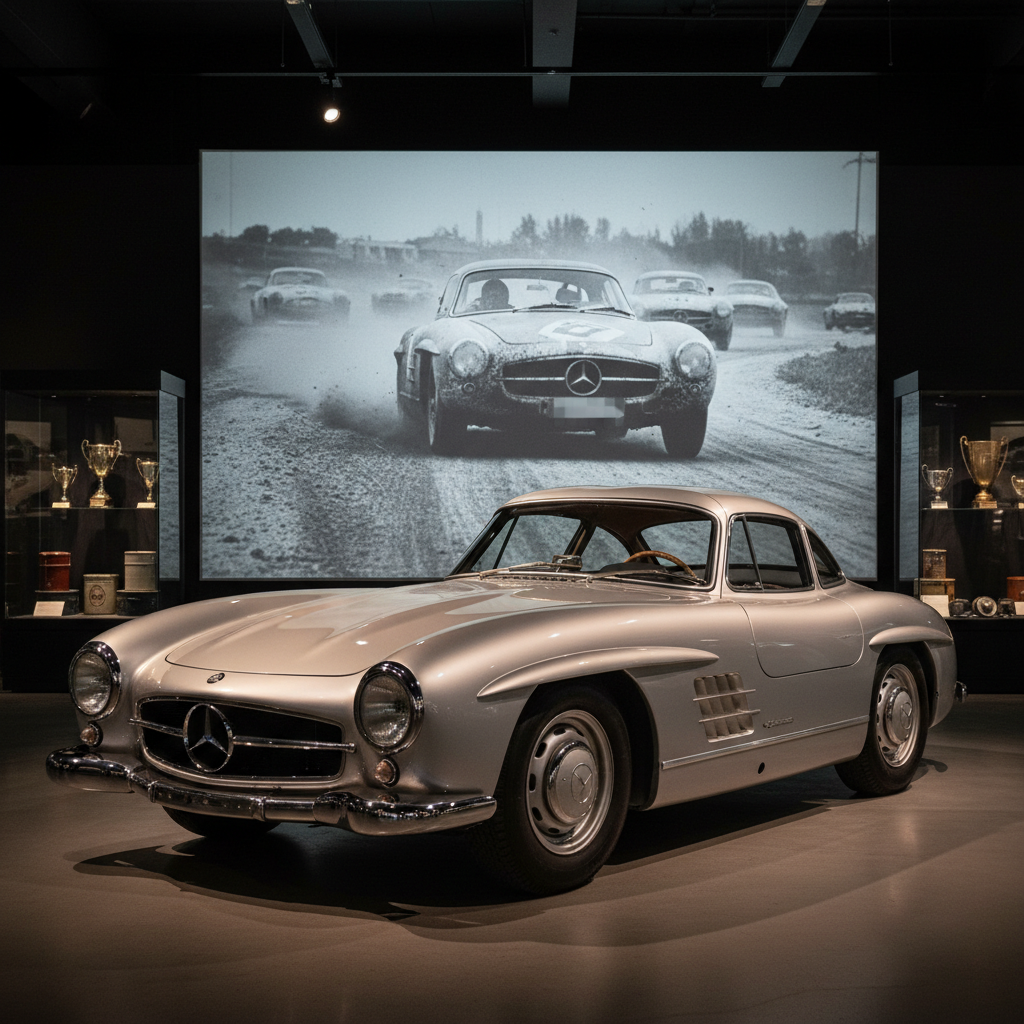
The journey of the gullwing design began on the racetrack. The W194 racing prototypes, which debuted in 1952, already featured these distinctive doors as they conquered prestigious endurance races such as the 24 Hours of Le Mans and the Carrera Panamericana. The performance of these early racing machines captivated the imagination of American automotive importer Max Hoffman, who saw immense potential for a road-going version in the burgeoning post-war U.S. market.
Hoffman’s persistence convinced Daimler-Benz to develop a production model. Within a remarkable five months, engineers transformed the race-bred W194 into the W198 production 300 SL, which debuted at the 1954 International Motor Sports Show in New York. The car was an instant sensation, not only for its revolutionary doors but also for its advanced technology, including the world’s first direct fuel injection system in a production car, which boosted its 3.0-liter inline-six engine to 215 horsepower. Capable of speeds up to 260 km/h (162 mph), it was widely recognized as the fastest production car of its era.
A Legacy Etched in Automotive History
While the gullwing doors were born out of a practical need, their dramatic aesthetic quickly elevated the 300 SL to an unparalleled status. It transcended its function to become a cultural phenomenon, symbolizing a golden age of automotive design and innovation. The influence of the gullwing motif extended beyond the automotive realm, inspiring designers and capturing the zeitgeist of an era that valued bold engineering and artistic flair.
However, the design was not without its practical considerations. The high sills, though structurally vital, made ingress and egress somewhat challenging, even with a tilt-down steering wheel to aid access. Furthermore, the gullwing design was incompatible with a convertible body style, leading to the development of the 300 SL Roadster in 1957, which featured a redesigned frame and conventional doors.
The Mercedes-Benz Classic archives, a vast repository spanning nearly 130 years of automotive history, continue to preserve and digitize countless documents, photographs, and technical reports related to such groundbreaking vehicles. These ongoing efforts ensure that the intricate stories behind automotive icons like the 300 SL Gullwing remain accessible and continue to offer fresh perspectives, allowing new generations to appreciate the blend of engineering brilliance and design daring that defines classic motoring. The newly highlighted details about the gullwing doors serve as a potent reminder that often, the most iconic features are born from the most demanding challenges, transforming limitations into timeless design triumphs.