Donald Campbell's Bluebird K7: A Legacy Restored, A Future Debated
Coniston Water, UK – The spirit of speed and the poignant legacy of Donald Campbell once again resonated across Coniston Water this week, as his iconic hydroplane, Bluebird K7, made a significant appearance following its extensive restoration. The event, dubbed the Bluebird K7 Festival, offered enthusiasts a rare opportunity to reconnect with a pivotal piece of British engineering and motorsport history, though the future of the restored vessel remains a carefully considered balance between demonstration and preservation.
From Tragic Loss to Painstaking Revival
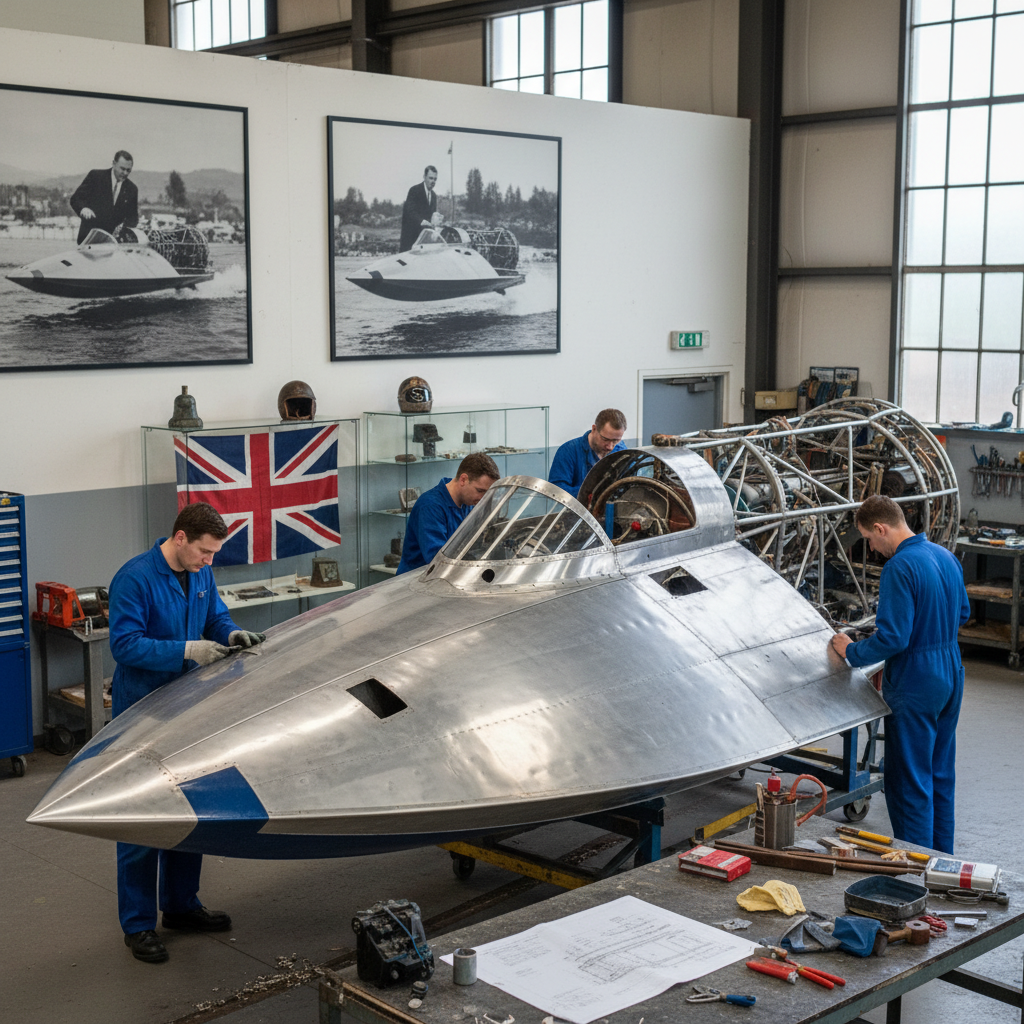
Bluebird K7, the vessel in which Donald Campbell tragically lost his life in 1967 during a world water speed record attempt, represents a powerful chapter in human endeavor. Campbell, a legend in his own right, had already set multiple land and water speed records, following in the formidable footsteps of his father, Sir Malcolm Campbell. His final, fatal run on Coniston Water saw K7 disintegrate at immense speed, claiming his life and consigning the advanced hydroplane to the lakebed for decades.
It wasn't until 1996 that the wreck of Bluebird K7 was finally located, a discovery that sparked immense interest and emotion. The subsequent recovery in 2001, led by diver Bill Smith and his team, was a monumental undertaking, bringing both the fragmented K7 and Campbell’s remains to the surface. This act of retrieval was not merely an archaeological exercise; it was a profound act of remembrance, allowing Campbell to be laid to rest at Coniston Cemetery and setting the stage for K7's remarkable journey back to completeness.
The Art and Challenge of Historical Restoration
The restoration of Bluebird K7 by Bill Smith's team was a project of immense scale and complexity, described as 'much debated' even as it neared completion. Such endeavors walk a fine line: honoring the original design and engineering while ensuring structural integrity and, where possible, operational capability. The meticulous process involved piecing together thousands of fragments, fabricating missing components, and applying specialist techniques to revive a vehicle that had spent over three decades submerged. Restoring a craft designed for extreme speeds requires an unparalleled level of precision, material science expertise, and historical research to ensure authenticity.
Every piece, from the hydroplane's distinctive blue livery to its jet engine components, underwent careful examination and restoration. Challenges would undoubtedly have included sourcing period-correct materials, reverse-engineering complex systems from damaged parts, and adhering to strict safety standards for a machine intended for such high-performance roles. The goal was not just to repair, but to resurrect K7 as a testament to Campbell’s ambition and the engineering prowess of its era.
Preserving a National Treasure at the Ruskin Museum
Upon the completion of its extensive restoration, K7 became the subject of a 'bitter ownership dispute' that ultimately saw the Coniston's Ruskin Museum take possession of the fully restored hydroplane. This placement ensures its long-term preservation and public accessibility, allowing generations to come to witness this magnificent machine firsthand.
The recent Bluebird K7 Festival, a week-long event marked by attempts to run the hydroplane on Coniston Water, underscored the emotional connection many still hold for Campbell and his legacy. While the experience was described as 'often frustrating, sometimes cold, sometimes surprisingly warm, and occasionally very exciting and emotional,' it highlighted the technical and logistical challenges inherent in operating such a historically sensitive machine.
The Ruskin Museum, as custodians of K7, acknowledges the desire for future demonstrations but maintains a cautious stance. They have not 'ruled out K7 being demonstrated on the lake again,' but concede that 'with the technical difficulty of running it, the safety aspects and the importance of preserving K7, it's probably unlikely.' This considered approach prioritizes the long-term integrity of the hydroplane, ensuring that this irreplaceable piece of history is protected for future generations, even if its days of high-speed runs are largely behind it. The ongoing care and display of Bluebird K7 continue to inspire and remind us of the daring spirit that pushed the boundaries of speed and human achievement.